



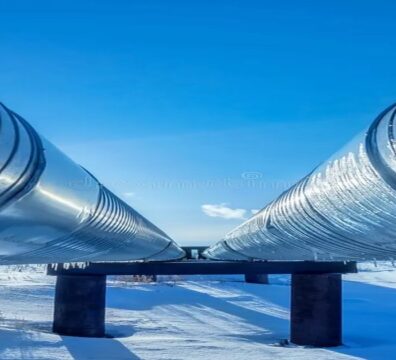
The global energy market in recent months has been reflected in a complex and fragile scenario, where politics and economics overlap. Russian oil and natural gas are at the center of attention, not only because of quantities and prices, but mainly because of strategic alliances that are being formed under pressure from the West and decisions from Asia. In this environment, the analysis of Nadia Martin Wiggen (Svelland Capital) illuminates the outlook for oil and gas, from India's stance and China's growing demand to Russia's role and implications for the global balance.
A key question is what will happen if India, which currently gets up to 36% of its crude from Russia, comes under enough pressure to start reducing those purchases. The US administration is already imposing tariffs on 50% of imports from India, setting the stage for a potential reversal. While there is no evidence yet that India intends to change course, the possibility is enough to spark discussions in Moscow and Beijing.
If India were to reduce its purchases of Russian crude, the immediate effect would be to lower the price of Russian oil. The reason is simple: Russia exports about 1.5 million barrels per day from its western ports. This production cannot be easily "closed", so it would have to find a new buyer. The most likely scenario is that up to 500,000 barrels per day could be absorbed by China.
The talks between the three leaders — of Russia, India, and China — are taking on critical importance. We are not just talking about a trade agreement, but about the cohesion of an alliance that has also been integrated into the BRICS framework.
China has set a rule to protect the diversification of its energy mix: not to exceed 20-25% of oil supplies from a single country. If it were to accept the additional 500,000 barrels of Russian crude, it would violate this rule. However, Beijing does not think only in terms of countries but also routes: via pipelines or via sea routes. Exports from Russia’s western ports, via the Black Sea, have a different geopolitical weight than flows arriving via Siberia by pipeline.
In natural gas, the picture is even more complicated. Currently, 10% of China's natural gas consumption is covered by Russia via pipelines. However, LNG deliveries are gradually increasing, with the Arctic 2 LNG, a sanctioned unit that nevertheless appears to have delivered cargo to China, being a prime example.
If all available Russia-Europe pipelines were opened today, the total capacity would be about 960 terawatt-hours: two-thirds through the never-operated Nord Stream 2, and the remaining one-third through Ukraine. In contrast, Russia is planning an expansion of gas exports to China that could reach 1,254 terawatt-hours. This will be done through three channels: the expansion of Power of Siberia 1, the full utilization of Arctic 2 LNG, and the construction of Power of Siberia 2.
China is doing everything it can to expand its own production, but demand is growing even faster. Citipex figures suggest an increase of 3.7% per year over the next five years. However, the actual rate may be closer to 5.6 to 6% per year. This means that China will need more energy, both from its own production and from imports.
This development is of enormous importance for the global LNG market, especially as new units are being prepared in the US (Plaquemines) and Qatar, with the prospect of production continuing to expand over the next decade.
While China is preparing for increased natural gas consumption, the oil market is in a completely different phase. Prices are trending towards monthly losses as oversupply builds. Estimates show that in the fourth quarter we will have a surplus of about 2 million barrels per day.
The third quarter saw small increases, but the big difference came from the closure of refineries in the Atlantic basin, about 500,000 barrels per day per quarter. This led the remaining refineries to operate at the limit, without having had time to build up product inventories. Diesel remains low and the market expects warehouses to fill in the fourth quarter. Then the weakness in the Brent curve, which remains in a state of strong backwardation, will also be visible.
The picture is becoming more complex with new refinery capacity expansions, around 500,000 barrels per day globally, with a peak in the Middle East. This is positive for shipping, because it means more crude will need to be transported to Asia.
At the same time, 500,000 barrels per day of refinery output in Russia have been shut down due to breakdowns. This means more crude is being exported, while products are being restricted. This creates a peculiar balance: a surplus of crude but a shortage of products like diesel.
All of this adds up to a narrative that shows the interdependence of politics and energy. India is under pressure from the US, but it knows that Russian crude is crucial to its energy security. China wants to keep the balance, but growing demand and lower costs of Russian flows are pushing it to work more closely with Moscow. Russia, pressured by sanctions, is turning east, investing in new pipelines and LNG that will go to Asia.
Meanwhile, the oil market is struggling with oversupply and the natural gas market is preparing for a competition that will be judged by both prices and geopolitical alliances.
| Futures Contract | Short-Term Trend | Medium-Term Trend | Long-term Trend |
|---|---|---|---|
| TTF Gas (October 25) | Cathodic — target 30,645 | Neutral — range movement | Cathodic until split > 37–42 |
| Brent Oil (November 25) | Neutral / Cathodic — Doji at 67.94 | Neutral — range 66.4–69.1 | Slope / Cathodic unless it exceeds 75 |
This article is a product of journalistic research and is provided solely for informational purposes.
It does not constitute investment advice or a solicitation to buy or sell any financial product.

Certified Technical Analyst (MSTA) and financial/sports writer with expertise in capital markets, trading systems and trading strategies.
Graduate of the Department of Statistics of the London School of Economics and Finance of ALBA Business School.